

The breathtaking visual world of Avatar changed the film industry forever. From realistic digital characters and immersive environments to stunning visual effects, the movie demonstrated how advanced VFX technology can transform storytelling. For many aspiring artists and creative students, watching Avatar sparks a simple question: How can I learn to create visuals like that?
The answer often begins with enrolling in an Advanced VFX Course that teaches the latest tools, techniques, and production workflows used in the entertainment industry. Whether you dream of working in films, OTT content, gaming, advertising, or animation, advanced VFX training can provide the technical and creative foundation needed to build professional-quality visual effects.
In this guide, we’ll explore how an advanced VFX program can help you develop Avatar-inspired skills, the technologies you’ll learn, career opportunities available after training, and how to choose the right course for your future.
Why Avatar Revolutionized the VFX Industry

When Avatar was released, it set new standards for visual storytelling. The film combined motion capture, CGI environments, digital creatures, realistic lighting, and advanced rendering techniques to create a believable fictional world.
What made Avatar special was not just the visual quality but the seamless integration of technology and creativity. Every scene was carefully designed using sophisticated VFX pipelines that required collaboration between artists, animators, compositors, modelers, and technical directors.
According to the Academy of Motion Picture Arts and Sciences and industry reports from visual effects organizations, films increasingly depend on digital effects to create environments and characters that would be impossible or extremely expensive to produce physically.
Understanding What an Advanced VFX Course Covers
An Advanced VFX Course teaches students the technical and creative skills needed to produce professional-quality visual effects. From CGI creation and compositing to motion tracking and rendering, the course covers every stage of the VFX production pipeline. This comprehensive training helps students prepare for real-world projects in film, television, gaming, and advertising.

Students learn how major studios create cinematic visuals by mastering:
1. CGI and Digital Environment Creation
Large-scale fantasy worlds like Pandora in Avatar are created using advanced 3D modeling and environment design techniques.
Students learn:
- Environment modeling
- Texture creation
- Landscape generation
- Digital matte painting
- Procedural world-building
These skills help artists create realistic forests, futuristic cities, alien worlds, and other immersive environments.
2. Motion Capture Techniques
Motion capture technology records human movement and translates it into digital characters.
Advanced training includes:
- Motion capture fundamentals
- Character rigging
- Animation cleanup
- Facial performance capture
- Performance-driven animation
This technology is widely used in films, gaming, and virtual production.
3. Advanced Compositing
Compositing combines multiple visual elements into a single final image.
Students learn:
- Green screen integration
- Rotoscoping
- Keying techniques
- Tracking and match moving
- Visual enhancement workflows
Compositing is one of the most essential skills in modern VFX production.
4. Lighting and Rendering
Realistic lighting helps digital objects blend naturally into scenes.
Training includes:
- Global illumination
- Physically based rendering
- HDRI lighting
- Shadow creation
- Reflection management
These techniques contribute significantly to the cinematic quality seen in blockbuster films.
Essential Software You Learn in an Animation and VFX Course
Modern VFX production relies on industry-standard software that enables artists to create realistic and visually stunning effects. A professional animation and vfx course introduces students to powerful tools used by leading studios worldwide. Learning these applications helps students build technical expertise and confidence in handling complex projects.
Professional studios rely on industry-standard software to create visual effects.
A quality animation and VFX course typically introduces students to:
Autodesk Maya
Widely used for:
- Modeling
- Animation
- Rigging
- Character creation
Houdini
Popular for:
- Simulations
- Procedural effects
- Destruction sequences
- Water and fire effects
Nuke
Used extensively for:
- Compositing
- Visual integration
- Color correction
- Final shot assembly
Adobe After Effects
Ideal for:
- Motion graphics
- Visual enhancements
- Broadcast graphics
- Basic compositing
Blender
A powerful and increasingly popular open-source platform for:
- Modeling
- Animation
- Rendering
- VFX production
Learning these tools prepares students for real-world studio environments.
How an Advanced VFX Course Develops Creative Thinking
VFX is not just about software skills; it also requires creativity and problem-solving abilities. An advanced course encourages students to think visually, develop unique ideas, and find innovative solutions to artistic challenges. This combination of technical knowledge and creative thinking is essential for producing memorable visual experiences.
Many people assume VFX is purely technical. In reality, successful VFX artists combine technology with creativity.
Students learn how to:
Visualize Complex Scenes
Artists must imagine scenes before they exist.
Training helps students:
- Develop visual storytelling skills
- Plan effects sequences
- Design cinematic compositions
Solve Creative Challenges
Every project presents unique technical and artistic problems.
Students learn how to:
- Troubleshoot workflows
- Improve visual realism
- Optimize rendering processes
Build Attention to Detail
Small details often determine whether an effect feels realistic.
Advanced VFX education encourages:
- Precision
- Observation
- Artistic refinement
These skills are highly valued by employers.
Learning Avatar-Style World Building
One of the most exciting aspects of VFX is creating entire digital worlds from scratch. Students learn how to design environments, ecosystems, and visual elements that feel immersive and believable. These world-building skills are widely used in films, games, and virtual reality experiences.

One of Avatar’s greatest achievements was creating an entire believable ecosystem.
Students studying advanced VFX learn techniques that contribute to world-building, including:
Asset Creation
Creating:
- Plants
- Creatures
- Buildings
- Props
Environmental Storytelling
Designing environments that communicate:
- Culture
- History
- Atmosphere
Procedural Generation
Using software tools to efficiently create large-scale worlds.
Digital Ecosystem Design
Understanding how landscapes, lighting, weather, and vegetation work together to create immersive environments.
These skills are increasingly important in films, gaming, and virtual production.
The Role of Virtual Production in Modern VFX
Virtual production is changing the way films and digital content are created by combining real-time rendering with traditional filmmaking. Students gain exposure to modern workflows that allow directors and artists to visualize scenes instantly. Understanding virtual production technologies gives aspiring VFX professionals a competitive advantage in the industry.
Virtual production has transformed how movies are made.
Studios now combine:
- Real-time rendering
- LED volume stages
- Motion capture
- Game engine technology
Students enrolled in advanced VFX programs gain exposure to:
Unreal Engine
Used for:
- Virtual environments
- Real-time rendering
- Interactive production workflows
Real-Time Visualization
Allows directors and artists to see results instantly during production.
Hybrid Workflows
Combining live-action footage with digital environments.
Virtual production is becoming a major hiring area within the entertainment industry.
Why Portfolio Development Matters
A strong portfolio is often the key to securing internships and job opportunities in the VFX industry. During an Advanced VFX Course, students work on projects that showcase their technical abilities and artistic creativity. A well-crafted portfolio demonstrates practical skills and helps employers assess a candidate’s potential.
An Advanced VFX Course helps students build:
Demo Reels
Professional demo reels showcase:
- Technical skills
- Creativity
- Software proficiency
Industry Projects
Many institutions include:
- Simulated studio projects
- Team collaborations
- Production pipelines
Specialization Samples
Students can create work focused on:
- Compositing
- Animation
- Modeling
- FX simulation
- Environment creation
A strong portfolio often plays a larger role than academic qualifications alone.
Career Opportunities After Completing an Advanced VFX Course
An Advanced VFX Course equips students with the technical expertise and creative skills needed to work in the fast-growing entertainment and digital media industries. As demand for high-quality visual content continues to rise across films, OTT platforms, gaming, advertising, and virtual production, skilled VFX professionals have access to a wide range of rewarding career opportunities. Here are some of the most popular career paths available after completing advanced VFX training.

The entertainment and digital media industries offer diverse career paths.
VFX Artist
A VFX Artist creates digital effects that enhance live-action footage or animated content. They work on scenes involving explosions, weather effects, magical elements, and other visual enhancements. This role requires creativity, technical skills, and a strong understanding of visual storytelling.
Compositor
Compositors combine multiple visual elements, such as CGI, live-action footage, backgrounds, and special effects, into a seamless final shot. Their work ensures that all visual components blend naturally and look realistic. Compositing is one of the most in-demand specializations in the VFX industry.
3D Environment Artist
Environment Artists design and build realistic or fantasy digital worlds used in films, games, and animations. They create landscapes, cities, forests, and other virtual settings that help bring stories to life. This role is ideal for individuals who enjoy world-building and visual design.
Character Artist
Character Artists are responsible for designing and modeling digital characters for movies, games, and animated projects. They focus on creating realistic details, facial expressions, clothing, and textures. Strong artistic skills and attention to detail are essential for success in this role.
FX Technical Artist
FX Technical Artists specialize in creating dynamic simulations such as fire, smoke, water, explosions, dust, and destruction effects. These effects add realism and excitement to visual productions. Professionals in this role often use advanced software like Houdini to create complex simulations.
Motion Graphics Designer
Motion Graphics Designers create animated graphics and visual content for advertisements, television programs, social media campaigns, and corporate videos. Their work combines graphic design principles with animation techniques to communicate messages effectively and creatively.
Virtual Production Artist
Virtual Production Artists work with real-time rendering technologies and virtual filmmaking tools. They help create digital environments and interactive scenes that can be visualized during production. This emerging field offers exciting opportunities as virtual production becomes more widely adopted in the entertainment industry.
Game Environment Designer
Game Environment Designers create immersive worlds and interactive settings for video games. They develop landscapes, buildings, and environmental assets that enhance gameplay experiences. The growing gaming industry has created significant demand for skilled environment designers.
Lighting and Rendering Artist
Lighting and Rendering Artists focus on creating realistic lighting setups and generating final-quality images for productions. Their work ensures that digital scenes have the correct mood, atmosphere, and visual appeal. Proper lighting is essential for making CGI elements appear believable.
VFX Supervisor
With experience, professionals can advance to the role of VFX Supervisor, overseeing entire visual effects projects. They coordinate teams, manage production workflows, and ensure creative and technical quality throughout the project. This leadership position offers excellent career growth opportunities.
Freelance VFX Professional
Many skilled artists choose to work independently as freelancers, providing VFX services to clients worldwide. Freelancing offers flexibility, exposure to diverse projects, and the opportunity to build a personal brand within the industry. Remote work opportunities have made freelancing increasingly popular among VFX professionals.
Animation and Multimedia Specialist
Graduates with VFX expertise can also explore careers in animation, multimedia production, advertising, and digital content creation. Their skills can be applied across various creative industries, making them versatile professionals with multiple career options.
By completing an Advanced VFX Course, students can access these exciting career opportunities while building a strong portfolio and industry-ready skill set.
According to industry reports from organizations such as
- Visual Effects Society (VES)
- Global media research firms
- Unreal Engine for Film & TV
- Foundry Nuke Learning Hub
Demand for skilled VFX professionals continues to increase as content production expands worldwide.
Why Kolkata Is Emerging as a VFX Education Hub

Kolkata has become an attractive destination for students interested in visual effects and animation training. The city offers access to quality educational institutions, experienced instructors, and growing opportunities within the creative industry. Students pursuing a VFX course in Kolkata can benefit from both affordability and industry-relevant learning experiences.
Students seeking a VFX course in Kolkata have access to growing opportunities in creative education.
Kolkata offers:
- Expanding media industry presence
- Affordable education options
- Access to professional training institutes
- Growing animation and gaming communities
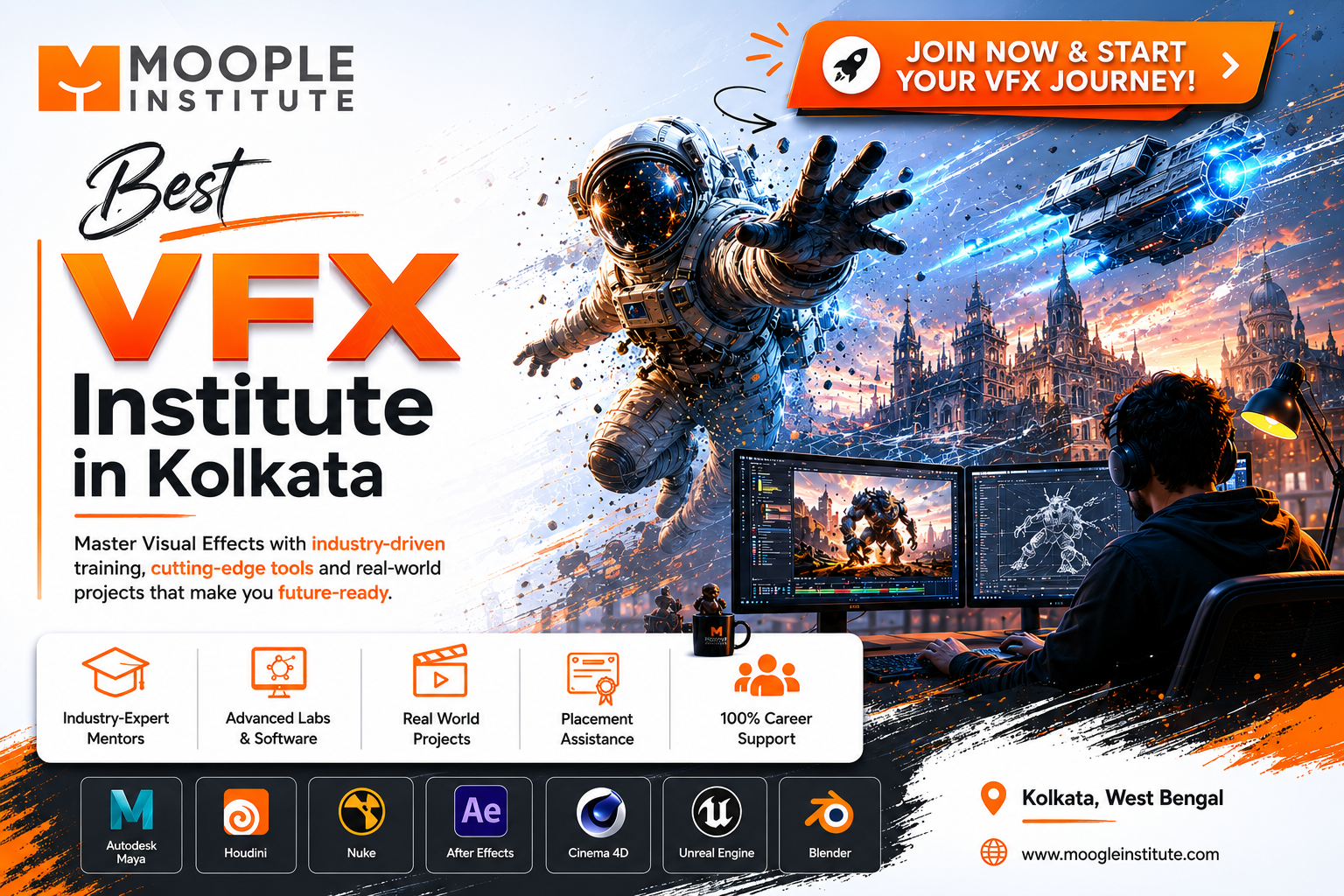
Moople Institute now offers comprehensive programs that combine animation, visual effects, and digital production skills under one curriculum.
📍 Find Your Way to Success
This makes the city an attractive destination for aspiring VFX professionals.
Understanding VFX Course Fees in Kolkata
One of the most common questions students ask concerns vfx course fees in Kolkata.
Course fees typically depend on:
Course Duration
Longer programs generally include:
- More software training
- Advanced projects
- Portfolio development
Infrastructure
Institutes with:
- Advanced computer labs
- Industry-standard software
- Dedicated production facilities
may have higher tuition fees.
Placement Support
Programs offering career guidance, internships, and placement assistance may also vary in pricing.
Students should evaluate value, curriculum quality, faculty expertise, and industry exposure rather than selecting solely based on fees.
Is a VFX Course for Beginners Worth It?
Absolutely,
A well-structured VFX course for beginners is designed to help students with little or no prior experience enter the exciting world of visual effects. These courses start with fundamental concepts and gradually introduce advanced techniques, making learning easier and more structured. Whether you dream of working in films, gaming, animation, or digital media, a beginner-friendly VFX course can provide the foundation needed to build a successful creative career.
Beginners learn:
Learn Industry Fundamentals from Scratch
Beginner VFX courses introduce essential concepts such as compositing, motion graphics, animation principles, and visual storytelling. Students gain a clear understanding of how visual effects are created and integrated into professional projects. Building a strong foundation helps learners progress confidently to more advanced topics.
Gain Hands-On Experience with Professional Software
One of the biggest advantages of a VFX course is the opportunity to learn industry-standard software used by professionals worldwide. Beginners become familiar with tools like Autodesk Maya, Adobe After Effects, Blender, and Nuke through practical projects. This hands-on experience develops technical skills that employers value.
Develop Creative and Technical Skills Together
Visual effects require a combination of creativity and technical knowledge. A beginner course helps students improve their artistic vision while learning the technical processes behind creating realistic visual effects. This balanced approach prepares learners for the challenges of modern VFX production.
Build a Professional Portfolio Early
A strong portfolio is essential for securing internships and entry-level positions in the VFX industry. Beginner courses often include project-based assignments that allow students to showcase their growing skills. Over time, these projects can become valuable additions to a professional demo reel.
Understand Real-World Production Workflows
Professional VFX studios follow structured production pipelines to complete projects efficiently. Beginners learn how different departments collaborate, from modeling and animation to compositing and final rendering. Understanding these workflows helps students transition more smoothly into industry environments.
Explore Diverse Career Opportunities
Completing a beginner VFX course can open doors to various creative career paths. Students may pursue roles such as Junior VFX Artist, Motion Graphics Designer, Compositor, 3D Artist, or Animation Assistant. As their experience grows, they can specialize in areas that match their interests and strengths.
Build Confidence for Advanced Learning
Starting with a beginner-friendly program allows students to learn at a comfortable pace without feeling overwhelmed. As they master the basics, they develop the confidence needed to tackle advanced VFX techniques and specialized training. This step-by-step learning journey creates a strong platform for long-term career growth.
Many successful VFX artists began with little or no prior experience before developing advanced skills through structured training.
Tips for Students Who Want to Create Avatar-Style Visuals
Creating visuals that match the quality and realism of movies like Avatar requires a combination of creativity, technical skills, and continuous practice. While blockbuster productions use large teams and advanced technology, students can start building similar skills through proper training and dedication.
Creating blockbuster-level visuals requires dedication and continuous learning.
1. Focus on Strong Fundamentals
A solid understanding of artistic and technical fundamentals is the foundation of great visual effects work.
Learn Composition: Understanding how elements are arranged in a scene helps create visually appealing shots.
Study Color Theory: Proper color usage enhances mood, realism, and storytelling.
Master Perspective: An accurate perspective makes digital environments look believable and immersive.
Understand Animation Principles: Learning movement, timing, and weight helps create realistic character and object animations.
2. Practice Consistently
Regular practice is essential for improving VFX skills and gaining confidence with industry tools.
Work on Small Projects: Short projects help build experience without becoming overwhelming.
Create Environment Designs: Designing landscapes and virtual worlds improves creativity and technical ability.
Experiment with Simulations: Practice creating smoke, fire, water, and particle effects to understand dynamics.
Challenge Yourself: Try recreating scenes from movies or creating original visual effects to enhance problem-solving skills.
3. Build a Professional Portfolio
A strong portfolio is often more important than academic qualifications when applying for VFX jobs.
Showcase Your Best Work: Include only your highest-quality projects and demo reels.
Highlight Technical Skills: Demonstrate modeling, compositing, animation, lighting, and simulation abilities.
Display Creative Thinking: Employers value artists who can solve visual challenges creatively.
Update Regularly: Continuously add new projects as your skills improve.
4. Learn Industry-Standard Software
Professional studios expect artists to be familiar with the tools used in real production environments.
Master Autodesk Maya: Widely used for modeling, animation, and rendering.
Learn Houdini: Essential for creating advanced simulations and visual effects.
Use Nuke for Compositing: A leading software for combining visual elements into final shots.
Explore Unreal Engine: Increasingly used for real-time rendering and virtual production workflows.
5. Study Real-World Visual Effects
Analyzing professional work helps students understand how high-quality visual effects are created.
Watch Behind-the-Scenes Videos: Learn how major studios create blockbuster effects.
Break Down Movie Shots: Study lighting, camera movement, and CGI integration.
Observe Natural Phenomena: Real-world references improve the realism of digital effects.
Follow Industry Trends: Stay updated with new technologies and production techniques.
6. Develop Patience and Attention to Detail
Creating realistic visual effects requires careful observation and precision.
Refine Your Work: Small improvements can significantly enhance visual quality.
Pay Attention to Lighting: Realistic lighting is often the key to believable CGI.
Check Every Frame: Professional artists review their work repeatedly before finalizing it.
Accept Feedback: Constructive criticism helps identify areas for improvement and accelerates growth.
7. Network with Industry Professionals
Building connections can open doors to internships, mentorships, and job opportunities.
Join VFX Communities: Participate in online forums and creative groups.
Attend Industry Events: Workshops and seminars provide valuable learning experiences.
Connect on Professional Platforms: Networking with artists and recruiters can lead to career opportunities.
Collaborate with Peers: Team projects help develop communication and production skills.
By following these tips and enrolling in an Advanced VFX Course, students can gradually develop the skills needed to create impressive, cinematic-quality visuals inspired by films like Avatar. Consistent learning, practice, and portfolio development are the keys to success in the competitive world of visual effects
The Future of VFX Careers
The visual effects industry is evolving rapidly as new technologies reshape how films, games, advertisements, and digital experiences are created. With the growth of streaming platforms, virtual production, gaming, and immersive media, the demand for skilled VFX professionals is expected to continue rising. Students who develop strong technical and creative skills through an Advanced VFX Course can access exciting career opportunities in a future driven by digital innovation.
The future of visual effects is incredibly promising.
Growing Demand for Streaming Content
Streaming platforms are investing heavily in original movies, web series, and digital content that rely on advanced visual effects. As audiences expect higher production quality, VFX artists play a crucial role in creating realistic environments, creatures, and cinematic effects. This trend is generating consistent job opportunities for trained professionals across the entertainment industry.
Expansion of Virtual Production
Virtual production combines real-time rendering, motion capture, and LED stage technology to transform modern filmmaking. Studios are increasingly adopting these techniques because they reduce production costs and improve creative flexibility. As a result, professionals with knowledge of virtual production tools and workflows are becoming highly sought after.
Growth of the Gaming Industry
The gaming sector continues to expand worldwide, creating demand for VFX artists who can develop realistic characters, environments, and special effects. Modern games require cinematic-quality visuals that enhance player immersion and storytelling. VFX professionals with gaming expertise can find opportunities in game development studios and interactive media companies.
Integration of Artificial Intelligence in VFX
Artificial intelligence is helping VFX artists automate repetitive tasks such as rotoscoping, motion tracking, and asset generation. Rather than replacing creative professionals, AI allows artists to focus more on design, storytelling, and innovation. Understanding AI-powered tools can help future VFX professionals work more efficiently and stay competitive.
Rise of Immersive Technologies
Technologies such as virtual reality (VR), augmented reality (AR), and mixed reality (MR) are creating new opportunities for visual effects artists. Businesses, educational institutions, gaming companies, and entertainment brands are using immersive experiences to engage audiences. VFX professionals who understand immersive content creation will be well-positioned for emerging career paths.
Increased Demand Across Multiple Industries
VFX skills are no longer limited to the film industry. Advertising agencies, architecture firms, educational platforms, healthcare companies, and corporate organizations increasingly use visual effects and 3D visualization. This diversification provides VFX professionals with a wider range of career opportunities and greater job stability.
Global Freelancing and Remote Work Opportunities
Advancements in digital collaboration tools have made remote work a common practice in the VFX industry. Artists can now work with international studios and clients from virtually anywhere in the world. This global accessibility allows skilled professionals to build flexible careers and explore freelance opportunities beyond their local market.
Continuous Learning and Career Growth
The VFX industry constantly evolves as new software, techniques, and technologies emerge. Professionals who commit to continuous learning can advance into specialized roles such as FX Technical Artist, VFX Supervisor, Environment Artist, or Virtual Production Specialist. An Advanced VFX Course provides the foundation needed to adapt and grow throughout a long-term creative career.
FAQs
1. What skills can I learn in an Advanced VFX Course?
Students learn CGI creation, compositing, motion graphics, simulation effects, lighting, rendering, tracking, environment design, and professional production workflows used in the entertainment industry.
2. Is a VFX course suitable for beginners?
Yes. A quality VFX course for beginners starts with fundamentals and gradually introduces advanced concepts, making it suitable for students with no prior experience.
3. What is the average duration of a VFX course?
Most programs range from 6 months to 24 months, depending on the curriculum depth and specialization level.
4. What career opportunities are available after completing a VFX course?
Graduates can work as VFX Artists, Compositors, Environment Artists, Motion Graphics Designers, Character Artists, FX Technical Artists, and Virtual Production Specialists.
5. How do I choose the best VFX course in Kolkata?
Look for industry-relevant curriculum, experienced faculty, portfolio-building opportunities, placement support, software training, and hands-on project experience.
Conclusion
The visual magic behind films like Avatar is the result of advanced technology, artistic creativity, and highly skilled professionals working together. By enrolling in an Advanced VFX Course, students gain access to the tools, techniques, and production workflows used across modern entertainment industries.
Whether your goal is to create breathtaking digital worlds, realistic characters, cinematic visual effects, or immersive gaming environments, professional training can provide the foundation needed for success. If you’re exploring a VFX course in Kolkata, now is an excellent time to invest in future-ready creative skills.
The VFX industry continues to grow as streaming platforms, gaming studios, film productions, and virtual production companies expand worldwide. Start building your portfolio, develop your expertise, and take the first step toward creating visuals that inspire audiences—just like Avatar.

About The Author


Leave a Reply